


316 316L
Kangtao
Stainless Steel Round Bar
ISO9001
Grade 300
Polishing, Pickling, Coating
1-2500mm
0.3~200mm
Customized
ASTM, JIS, GB, EN
| Quantity: | |
|---|---|


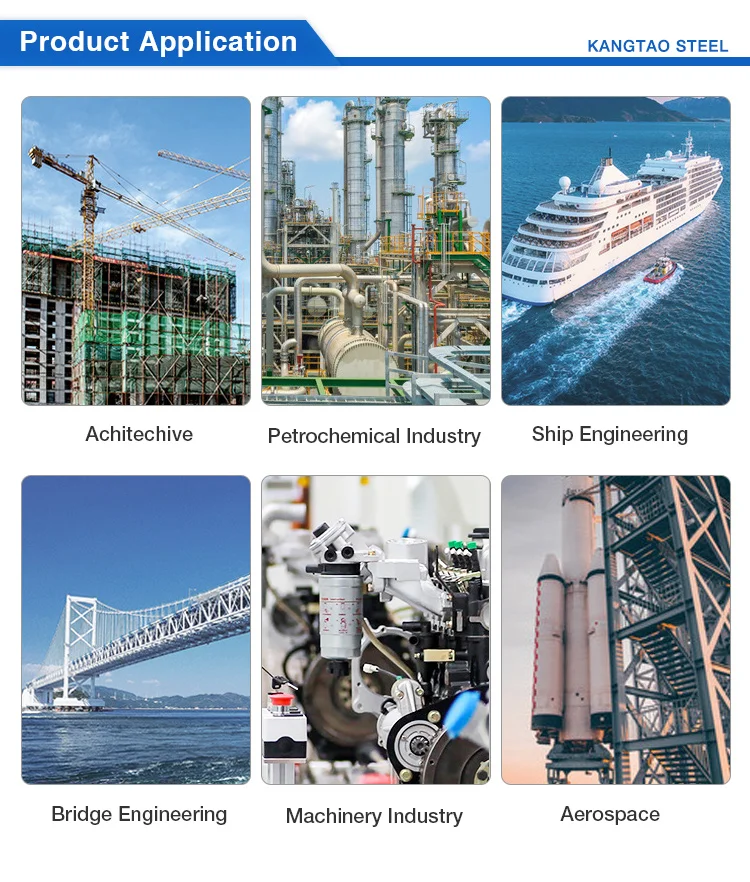
316/316L stainless steel round bars are used for facade tie rods, glass spider fittings, handrail posts, shading frames, and architectural cables, balancing structural strength and aesthetics. Polished or turned finishes are recommended for consistent surface roughness and corrosion appearance. For coastal or high-humidity sites, 316L stainless steel round bar improves weld corrosion resistance. Supply per ASTM/JIS/GB/EN with MTC/PMI, third-party inspection, and ISO9001 compliance.
In refining and chemical units, 316 stainless steel round rods serve pump shafts, valve stems, flange fasteners, clamps, instrument supports, and corrosion-resistant connectors exposed to chlorides, sulfides, or mild acids/alkalis. Buyers focus on pitting/crevice corrosion and batch chemistry stability; MTC/PMI confirm alloying (notably Cr/Ni and Mo tendency). Pickled finishes reduce contamination risk; 316L is recommended for welds with post-weld pickling/passivation.
316/316L stainless steel round bars are used for deck and interior fasteners, railing posts, hatch hardware, shafts and supports in propulsion/steering systems, and port facility fixtures. Marine splash zones and saline atmospheres demand strong pitting resistance; 316L is preferred. Polished or coated finishes enhance corrosion appearance and cleanliness. Supply per relevant clauses such as ASTM A276/A479, with third-party inspection available.
Applied to tie rods, pins, bearing components, cable clamps, and instrumentation parts requiring strength, tight tolerances, and resistance to de-icing salts. For cold regions and coastal bridges, pickled finish plus rust preventive oil protects during transport and installation; on-site polishing can be added. Diameter × length customization and chamfered ends improve assembly efficiency and appearance consistency.
Widely used for turned/milled parts, guide rods, drive shafts, seal seats, jigs/fixtures, and food equipment components, focusing on machinability and cleanliness. Options include cold-drawn bright, turned-polished, or pickled surfaces. For higher cutting efficiency, specify sulfur control and stress-relief preferences; feasibility will be evaluated per ASTM/JIS/GB/EN and reflected on the MTC. Dimensional tolerances and hardness/tensile tests supported, with third-party inspection.
Used in ground tooling, maintenance fixtures, instrument supports, and general fasteners, emphasizing corrosion resistance and dimensional stability. 316L stainless steel round bar offers better weld corrosion reliability for welded assemblies. Choose polished or coated finishes for consistent assembly quality.
Performance aligned with supply condition: KANGTAO 316/316L stainless steel round bars can be supplied to your specified standard set (ASTM/JIS/GB/EN) and surface state (polishing/pickling/coating). Tensile/yield/elongation and hardness (HB/HRC) depend on condition and size; actual values are issued on the MTC, with third-party inspection available.
Dimensional stability: diameter × length customization and cut-to-length available; polished/pickled/coated surfaces help ensure appearance consistency for architecture and bridge assembly.
316L for welded zones: Above table shows 316L with C≤0.03, which helps reduce sensitization risk and improves corrosion resistance in weldments.
Process and post-treatment: control heat input per joint design; after welding, perform pickling/passivation to remove HAZ discoloration and contaminants.
Turning/milling capable: widely used for turned and milled components in machinery and shipbuilding; specify surface state (polished/pickled/coated) and tolerance targets at ordering for predictable tool life and Ra.
Machinability options: if you require a chemistry window tuned for cutting (e.g., sulfur control) or stress-relief requirements, indicate this in your RFQ; feasibility will be evaluated against ASTM/JIS/GB/EN and process capability.
Cut-to-length and ends: cut to drawing with optional chamfering and marking for faster field assembly in petrochemical and bridge projects.
Environment fit: appropriate for chloride-bearing conditions, marine splash zones, and petrochemical media—common in ship engineering, port facilities, and process equipment connections.
Surface state vs. corrosion: polished and pickled finishes provide cleaner surfaces, reducing corrosion risk from contaminants and weld spatter residues.
Protection options: upon order, apply rust preventive oil, end/side guards, moisture barrier film, and pallet/crate reinforcement suitable for sea/land freight.
Storage notes: keep dry and clean to avoid cross-contamination with carbon steel; isolate from strong chlorides and acidic atmospheres; for long-term storage, inspect packaging and renew rust inhibitor periodically.
Stainless steel is an alloy steel with smooth surface, high weldability, corrosion resistance, polishability, heat
resistance, corrosion resistance and other characteristics. It is widely used in various industries and is an important material in modern industry. Stainless steel is divided into austenitic stainless steel, ferritic stainless steel, martensitic stainless steel, and duplex stainless steel according to the structure state.It contains 15% to 30% chromium and has a body-centered cubic crystal structure. This type of steel generally does not contain nickel, and sometimes contains a small amount of Mo, Ti, Nb and other elements. This type of steel has the characteristics of large thermal conductivity, small expansion coefficient, good oxidation resistance, and excellent stress corrosion resistance.
| Austenitic Stainless Steel | 201, 301, 304, 305, 310, 314, 316, 321, 347, 370, etc | |||
| Martensitic Stainless Steel | 410, 414, 416, 416, 420, 431, 440A, 440B, 440C, etc | |||
| Duplex Stainless Steel | S31803, S32101, S32205, S32304, S32750, etc | |||
| Ferritic Stainless Steel | 429, 430, 433, 434, 435, 436, 439, etc | |||
What's the difference between 316 and 316L? How to choose?
The key difference is carbon: 316L has C≤0.03, improving weld corrosion resistance—better for welded structures and chloride/marine service. For non-welded parts with specific strength needs, 316 may be selected.
Can I get samples before order ?
Yes, of course. Usually our samples are free,we can produce by your samples or technical drawings.
What is your payment terms?
Our usual payment term is 30% deposit, and rest against B/L. L/C is also acceptable. EXW, FOB,CFR, CIF.
Do you accept the third party inspection?
Yes, absolutely we accept.
Will you delivery the goods on time?
Yes, we promise to provide best quality products and delivery on time. Honesty is our company's tenet.
316/316L stainless steel round bars are used for facade tie rods, glass spider fittings, handrail posts, shading frames, and architectural cables, balancing structural strength and aesthetics. Polished or turned finishes are recommended for consistent surface roughness and corrosion appearance. For coastal or high-humidity sites, 316L stainless steel round bar improves weld corrosion resistance. Supply per ASTM/JIS/GB/EN with MTC/PMI, third-party inspection, and ISO9001 compliance.
In refining and chemical units, 316 stainless steel round rods serve pump shafts, valve stems, flange fasteners, clamps, instrument supports, and corrosion-resistant connectors exposed to chlorides, sulfides, or mild acids/alkalis. Buyers focus on pitting/crevice corrosion and batch chemistry stability; MTC/PMI confirm alloying (notably Cr/Ni and Mo tendency). Pickled finishes reduce contamination risk; 316L is recommended for welds with post-weld pickling/passivation.
316/316L stainless steel round bars are used for deck and interior fasteners, railing posts, hatch hardware, shafts and supports in propulsion/steering systems, and port facility fixtures. Marine splash zones and saline atmospheres demand strong pitting resistance; 316L is preferred. Polished or coated finishes enhance corrosion appearance and cleanliness. Supply per relevant clauses such as ASTM A276/A479, with third-party inspection available.
Applied to tie rods, pins, bearing components, cable clamps, and instrumentation parts requiring strength, tight tolerances, and resistance to de-icing salts. For cold regions and coastal bridges, pickled finish plus rust preventive oil protects during transport and installation; on-site polishing can be added. Diameter × length customization and chamfered ends improve assembly efficiency and appearance consistency.
Widely used for turned/milled parts, guide rods, drive shafts, seal seats, jigs/fixtures, and food equipment components, focusing on machinability and cleanliness. Options include cold-drawn bright, turned-polished, or pickled surfaces. For higher cutting efficiency, specify sulfur control and stress-relief preferences; feasibility will be evaluated per ASTM/JIS/GB/EN and reflected on the MTC. Dimensional tolerances and hardness/tensile tests supported, with third-party inspection.
Used in ground tooling, maintenance fixtures, instrument supports, and general fasteners, emphasizing corrosion resistance and dimensional stability. 316L stainless steel round bar offers better weld corrosion reliability for welded assemblies. Choose polished or coated finishes for consistent assembly quality.
Performance aligned with supply condition: KANGTAO 316/316L stainless steel round bars can be supplied to your specified standard set (ASTM/JIS/GB/EN) and surface state (polishing/pickling/coating). Tensile/yield/elongation and hardness (HB/HRC) depend on condition and size; actual values are issued on the MTC, with third-party inspection available.
Dimensional stability: diameter × length customization and cut-to-length available; polished/pickled/coated surfaces help ensure appearance consistency for architecture and bridge assembly.
316L for welded zones: Above table shows 316L with C≤0.03, which helps reduce sensitization risk and improves corrosion resistance in weldments.
Process and post-treatment: control heat input per joint design; after welding, perform pickling/passivation to remove HAZ discoloration and contaminants.
Turning/milling capable: widely used for turned and milled components in machinery and shipbuilding; specify surface state (polished/pickled/coated) and tolerance targets at ordering for predictable tool life and Ra.
Machinability options: if you require a chemistry window tuned for cutting (e.g., sulfur control) or stress-relief requirements, indicate this in your RFQ; feasibility will be evaluated against ASTM/JIS/GB/EN and process capability.
Cut-to-length and ends: cut to drawing with optional chamfering and marking for faster field assembly in petrochemical and bridge projects.
Environment fit: appropriate for chloride-bearing conditions, marine splash zones, and petrochemical media—common in ship engineering, port facilities, and process equipment connections.
Surface state vs. corrosion: polished and pickled finishes provide cleaner surfaces, reducing corrosion risk from contaminants and weld spatter residues.
Protection options: upon order, apply rust preventive oil, end/side guards, moisture barrier film, and pallet/crate reinforcement suitable for sea/land freight.
Storage notes: keep dry and clean to avoid cross-contamination with carbon steel; isolate from strong chlorides and acidic atmospheres; for long-term storage, inspect packaging and renew rust inhibitor periodically.
Stainless steel is an alloy steel with smooth surface, high weldability, corrosion resistance, polishability, heat
resistance, corrosion resistance and other characteristics. It is widely used in various industries and is an important material in modern industry. Stainless steel is divided into austenitic stainless steel, ferritic stainless steel, martensitic stainless steel, and duplex stainless steel according to the structure state.It contains 15% to 30% chromium and has a body-centered cubic crystal structure. This type of steel generally does not contain nickel, and sometimes contains a small amount of Mo, Ti, Nb and other elements. This type of steel has the characteristics of large thermal conductivity, small expansion coefficient, good oxidation resistance, and excellent stress corrosion resistance.
| Austenitic Stainless Steel | 201, 301, 304, 305, 310, 314, 316, 321, 347, 370, etc | |||
| Martensitic Stainless Steel | 410, 414, 416, 416, 420, 431, 440A, 440B, 440C, etc | |||
| Duplex Stainless Steel | S31803, S32101, S32205, S32304, S32750, etc | |||
| Ferritic Stainless Steel | 429, 430, 433, 434, 435, 436, 439, etc | |||
What's the difference between 316 and 316L? How to choose?
The key difference is carbon: 316L has C≤0.03, improving weld corrosion resistance—better for welded structures and chloride/marine service. For non-welded parts with specific strength needs, 316 may be selected.
Can I get samples before order ?
Yes, of course. Usually our samples are free,we can produce by your samples or technical drawings.
What is your payment terms?
Our usual payment term is 30% deposit, and rest against B/L. L/C is also acceptable. EXW, FOB,CFR, CIF.
Do you accept the third party inspection?
Yes, absolutely we accept.
Will you delivery the goods on time?
Yes, we promise to provide best quality products and delivery on time. Honesty is our company's tenet.